How vision works
The best way to understand function of the eye is to compare it to a camera. A camera creates images by focusing on an object and allowing specific amounts of light to pass through a hole to create a visual impression on film. The eye functions in much the same way.
When light enters the eye, it passes through the cornea (camera lens) where 2/3 of focus is achieved. The light then passes through the pupil where the iris (aperture) adjusts the amount of light that is allowed to enter. The rema
...More
Astigmatism
Astigmatism occurs in nearly 30% of the non-Asian population. In an eye with astigmatism, the front of the cornea is not equally curved; it is slightly oval in shape, like a football. Light rays entering the eye bend unequally, resulting in a distorted image. Astigmatism usually occurs in conjunction with myopia (nearsightedness) or hyperopia (farsightedness), and is a complicating factor for refractive surgery.
Correcting Astigmatism
Astigmatism can be corrected with eyeglasses, cont
...More
Farsightedness (Hyperopia)
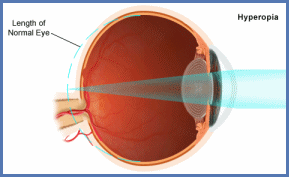
Hyperopia or farsightedness is very common, affecting up to 62% of people over the age of 40. Hyperopia occurs when the eyeball is too short or the cornea is too flat. When rays of light enter a hyperopic (short) eyeball, they are focused behind the retina instead of directly on the retina where light must be directed for normal vision. Because of this, the focusing apparatus in the eye must work constantly to make up for the problem and focus images. Symptoms of farsightedness can include eyest
...More
Nearsightedness (Myopia)
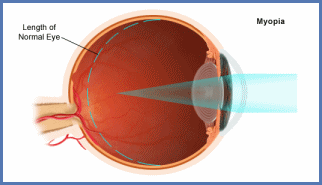
Myopia or nearsightedness is very common, affecting 26% of the non-Asian population. (Myopia occurs at a much higher rate in the Asian population.) It is a condition in which people have difficulties seeing objects in the distance, but may have no problems focusing on objects that are up close. This ability to see "near" but not far is why this condition is more commonly called "nearsightedness."
Myopia occurs when the eyeball is too long or the cornea is too steep. When rays of light enter a
...More
Presbyopia
People often confuse farsightedness with another condition called presbyopia, which occurs as a normal result of aging. Presbyopia affects most of those over the age of 40 and all over the age of 51, as the aging process affects the eyes' natural ability to bring near objects into focus.
Presbyopia occurs when the lens inside the eye loses flexibility, preventing accurate focusing on objects that are up close. People with this condition may experience eye fatigue when reading in poor lighting
...More